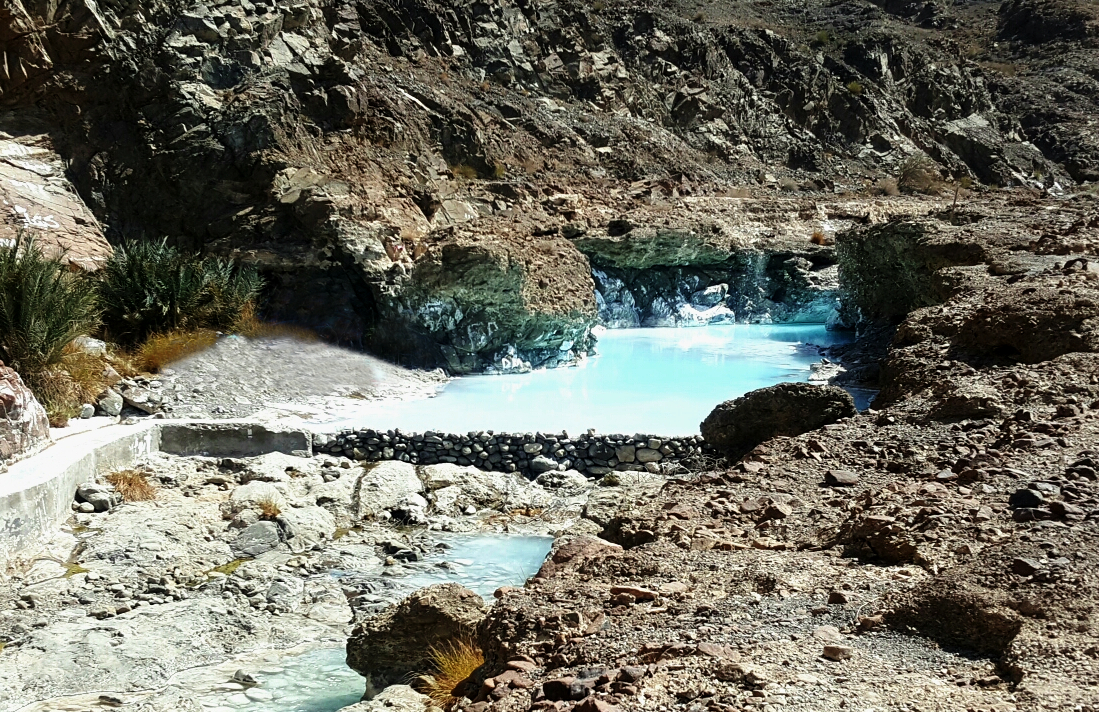
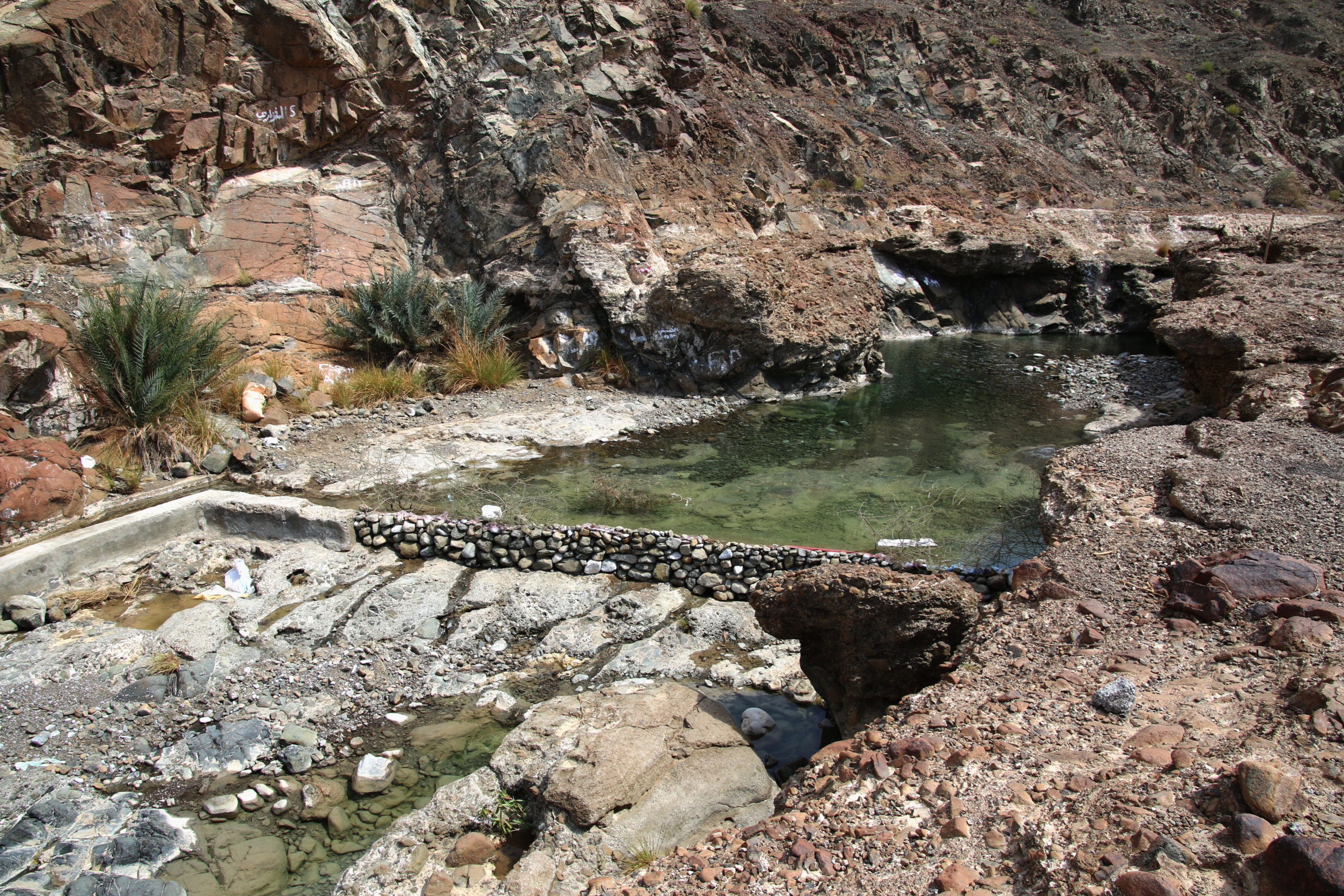
Mineral springs go largely unnoticed in Oman while tourists and other visitors flock to and enjoy the blue pools that are intimately associated with and originate largely from these mineral springs.
In a nutshell, surface waters (meteoric waters) flow through certain rock sequences that are not only common in Oman but are world class examples of their type – these are known as ophiolites (and in particular the Semail Ophiolite). These ophiolite sequences of rocks are referred to as being ultrabasic being low in quartz but high in iron and magnesium rich minerals such as olivines, pyroxenes and calcium rich feldspars.
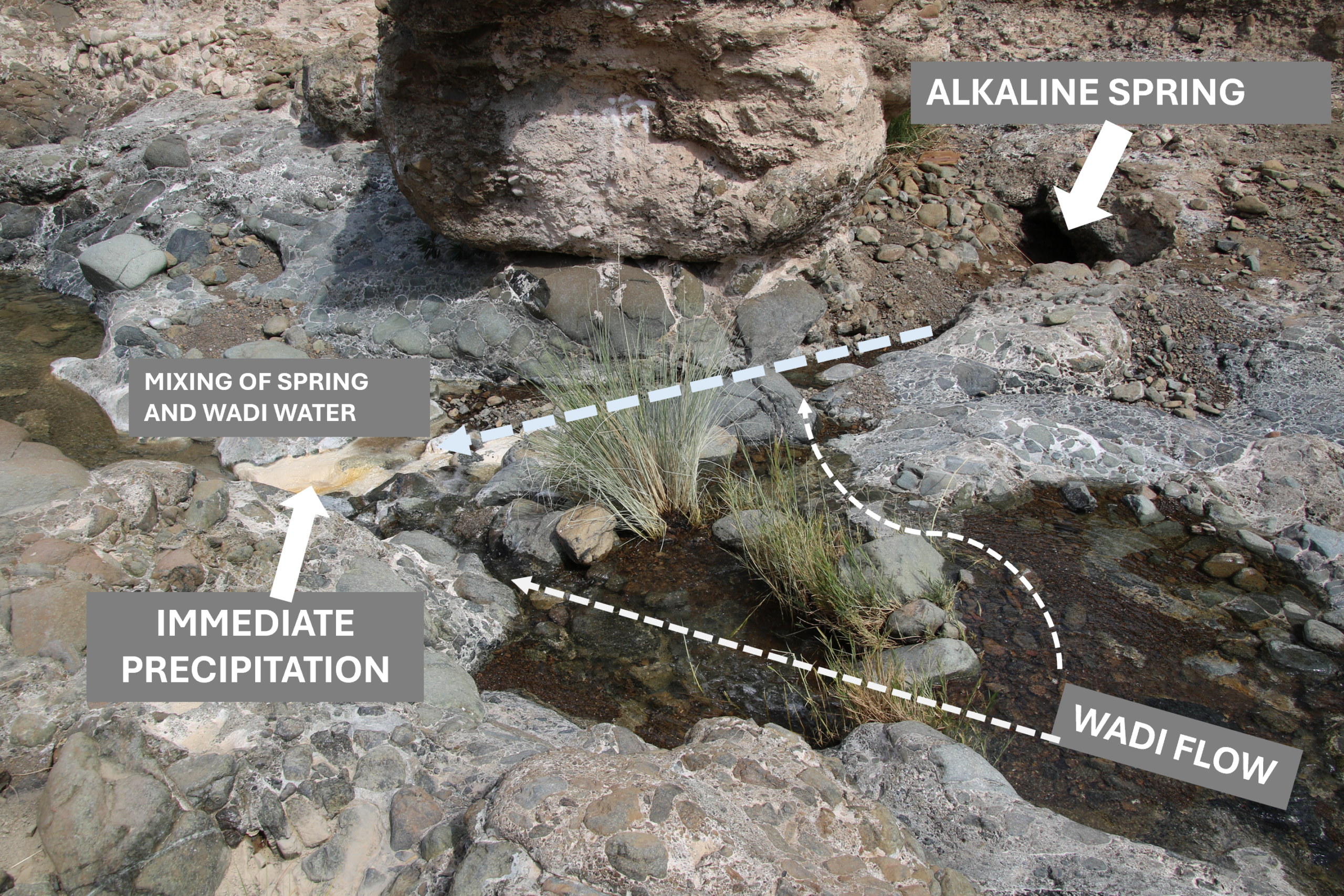
The meteoric waters alter these mierals and release an over abundance of Calcium (Ca), magnesium (Mg) into the groundwaters. These minerals are released as highly alkaline springs in wadis and take up carbon dioxide from the atmosphere which causes depositon of Ca and Mg carbonates when mixed with lower less alkaline wadi waters.
The mineral springs are highly alkaline (pH values 11 to 13 are common) while natural wadi water is neutral at arounf 7 or 8.
Why blue pools? As the neutral wadi water mixes with alkaline water from the springs, the spring water can not hold the high levels of calcium and magnesium in solution and this is precipitated as a variety of Ca and Mg carbonates. This begins at the Sahban Spring within a few centimeters of the mixing point (click for image). It continues so long as spring water and wadi water are flowing gently.
Why are blue pools not always blue? Quite simply, if rainwater doesn’t flow through the ophiolite then alkaline spring water fails to transport enough Ca and Mg. Equally when heavy rains occur the volume of wadi water often flushes out the blue pools and removes all of the white precipitate. It’s possible to visit a blue pool one day yet its gone one day later if it rains overnight. (click to view before rain and after rain.)